A clear PET bottle starts as small plastic pellets and passes through a few precise steps. Here is the whole process, start to finish, in plain language.
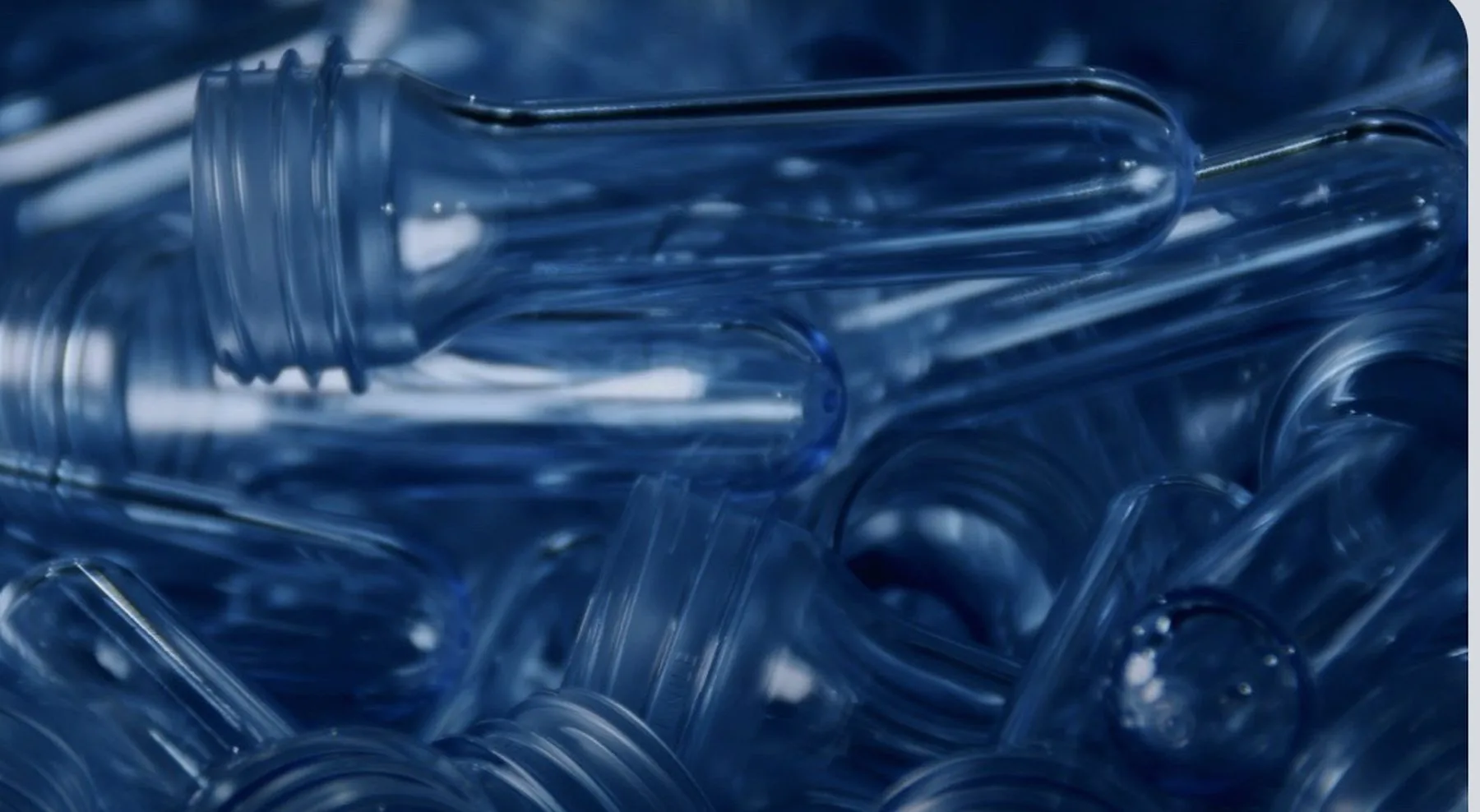
1. Resin drying
Bottle-grade PET resin absorbs moisture, which would degrade the polymer (hydrolysis) if it were melted wet. So the resin is dried to a low dew point before processing — a quiet but critical first step.
2. Injection moulding the preform
The dried resin is melted and injection-moulded into a preform — a thick, test-tube-shaped intermediate with the final bottle’s neck and threads already formed. Preforms are dense and small, which is why they ship far more efficiently than blown bottles (see preforms or finished bottles).
3. Reheat
To become a bottle, the preform is reheated in an infrared oven to a precise, even temperature profile — soft enough to stretch, not so hot it loses shape. Even reheat is the difference between a clear, strong wall and defects like a thin shoulder or stress-whitening.
4. Stretch-blow moulding (SBM)
The hot preform goes into a bottle mould; a stretch rod pushes it down (axial stretch) while high-pressure air blows it out against the mould wall (hoop stretch). This bi-axial stretch aligns the PET molecules — that is what makes the wall clear, strong and able to hold pressure. The neck never blows; it stays exactly as moulded.
5. The finished bottle
The bottle cools in the mould, is ejected, and is ready to fill and cap. Single-stage machines do injection and blowing in one line; two-stage machines — the common high-volume setup — make preforms first and blow them later, often at the filler’s own site. See single-stage vs two-stage.
Where Delta fits
Delta El Nile for Industry supplies the preform — the engineered intermediate that sets bottle weight, strength and cost — across 62 SKUs from 9 g water to 668.5 g returnable. Your blow line turns it into the bottle. Compare the range or build an RFQ.