
Lower carbon, engineered in.
Responsible PET packaging at Delta El Nile for Industry rests on three levers — recycled content (rPET), lightweighting, and certified, efficient manufacturing. We supply food-grade rPET blends for selected customer programmes; the ratio is agreed per customer and application.

From rPET pellet to future.
We blend food-grade rPET into production today for selected customer programmes, with the ratio agreed per customer and application. Lower embodied carbon, the same shelf performance.
Model your CO₂e saving →How we lower packaging carbon.
Recycled content (rPET)
Food-grade rPET blends ship today for selected customer programmes, and we are actively expanding food-contact rPET across the range. The rPET ratio is agreed per customer and application — subject to food-grade rPET supply and your destination market’s regulatory approvals. Our 2030 roadmap sets out the capacity and rPET-content targets behind this expansion.
Lightweighting
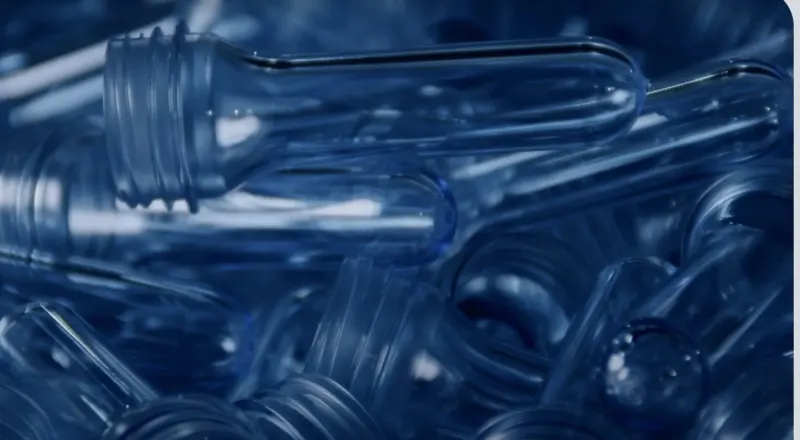
Every gram removed from a preform lowers both material use and carbon. We help customers right-weight preforms without sacrificing top-load, ESCR or shelf life — see our PET preform weight guide and the Preform → Bottle Advisor.
Certified, efficient manufacturing
Our quality and food-safety systems are certified to ISO 9001 and FSSC 22000 V6, alongside ISO 14001 environmental management. High line efficiency on the Husky platform minimises scrap and energy per part.
Beyond carbon — responsible, certified operations.
Environmental
ISO 14001 environmental management, recycled-content (rPET) expansion and lightweighting, with a fully transparent carbon methodology (below). Our 2030 roadmap sets the capacity and rPET-content targets.
Social & ethics
SEDEX supply-chain ethics membership covers labour standards, health & safety and business ethics — independently auditable. Customer and regulatory audits can be hosted at our New Salhiya City factory on request.
Governance & quality
ISO 9001 quality and FSSC 22000 V6 food-safety management, plus an independent EcoVadis sustainability rating. Total PET tonnage, rPET volumes and energy intensity are open to customers and auditors. Verify our credentials →
Our 2025 numbers — measured, not marketed.
Verified operating data for our New Salhiya City plant, reporting year 2025. We publish what we measure and label what is still being finalised — no rounding to zero, no unaudited claim dressed as a result.
92,000 t
PET resin processed
Total throughput — Delta-purchased and customer-supplied resin.
9%
Recycled content (rPET)
Post-consumer, food-grade rPET supplied by customers for conversion (~8,000 t of 92,000 t).
~50,980 MWh
Grid electricity
Cost-derived; metered kWh being finalised.
~0.58 MWh/t
Energy intensity
Electricity per tonne of PET processed.
~23–27k tCO₂e
Scope 2 (location-based)
Estimate — official Egypt grid factor being confirmed for 2025.
~145 tCO₂e
Scope 1 (estimate)
From 3 diesel forklifts (7 of 10 already electric); ~54,000 L/yr at ~3 L/h — metered fuel to confirm.
Zero
Recordable injuries
Zero recordable, zero lost-time, zero fatalities in 2025 (TRIR 0 / LTIFR 0).
700
Employees
Workforce at the New Salhiya City plant.
100% by 2027
Electric forklift fleet (target)
2025 baseline ~70% electric; target to retire the remaining diesel units by 2027.
Year-on-year (directional estimate — not separately metered): 2024 operating volumes were approximately 15% below 2025 (a management estimate) — i.e. ≈75,360 t resin, ≈43,330 MWh electricity, ≈19,600 tCO₂e Scope 2 — so 2025 reflects roughly 18% growth, with per-tonne intensities holding about flat. Metered 2024 figures will replace this estimate.
Reporting year 2025, New Salhiya City plant. Figures are not externally assured. Cost-derived and estimated values are labelled and will be replaced with metered/verified data; absolute figures are kept alongside intensities. Recycled content reflects customer-supplied rPET converted by Delta El Nile, not Delta's own procurement.
Designed to be recycled — and EPR-ready.
PET is the world’s most-collected and most-recycled plastic — resin identification code #1 — and the only mainstream packaging polymer with proven food-grade bottle-to-bottle recycling. We engineer our preforms and closures to stay in that loop, and to qualify under the recycled-content and recyclability rules that Extended Producer Responsibility (EPR) schemes and packaging taxes increasingly reward.
Mono-material, clear PET
Clear and light-blue PET preforms — no carbon black, no PVC — are the highest-value input for bottle-to-bottle recyclers and sort cleanly on near-infrared lines. We advise on colour and additive choices that keep your bottle recyclable.
Tethered-cap-ready necks
PCO 1881 and our lightweight finishes accept tethered closures, so your pack can meet cap-retention requirements in the markets that mandate them — without a neck redesign.
Recycled content, per programme
Food-grade rPET blended with virgin PET at a ratio agreed per customer and application — so your pack can hit recycled-content thresholds without re-tooling. Estimate the CO₂ saving →
Compatible closures
Our PP/HDPE caps and PET preforms separate cleanly in the recycling stream, and material declarations are provided on request to support your design-for-recycling assessment.
EPR fees, plastic taxes and recyclability rules differ by market and change often — and they increasingly favour recyclable, recycled-content packaging. Tell us your destination market and target recycled content, and we’ll align the specification with you. Talk to our team →
Where we’re heading by 2030.
Public, time-bound commitments — the trajectory behind the levers above. Progress is shared with customers and auditors on request.
Recycled content (rPET)
50% recycled content across all food-grade preforms by 2030 — on ISCC PLUS-certified, food-contact-approved rPET.
Renewable energy
50% of plant energy from renewables by 2030, led by on-site solar PV — lowering scope-2 emissions per preform.
Forward-looking targets — see our full 2030 roadmap for the year-by-year plan.
Carbon methodology & assumptions
Every CO₂e figure on this site and in the Carbon Calculator is computed transparently from published life-cycle factors — not company estimates. These are the exact inputs and boundaries.
Emission factors
- Virgin PET — 2.34 kg CO₂e/kg (Plastics Europe Eco-profile, 2024)
- rPET — 0.60 kg CO₂e/kg (Petcore Europe LCA, 2022)
Scope & boundary
Resin-stage (cradle-to-resin) CO₂e per kg of PET. Conversion, transport and end-of-life are out of scope, so the figures isolate the recycled-content lever. A 50% rPET blend cuts resin-stage CO₂e by ~37% vs all-virgin; 100% rPET by ~74%.
Sensitivity band (±15%)
LCA factors vary by source and region, so every result is shown as a ±15% band applied symmetrically to both factors — never a single false-precision number.
Real-world equivalents
- 1 passenger car ≈ 4.6 t CO₂e/yr (EPA passenger-vehicle average)
- 1 mature tree ≈ 22 kg CO₂e/yr (US Forest Service)
Per-tonne model figures are illustrative for planning. Company totals — total PET tonnage processed, rPET volumes and energy intensity — are available to customers and auditors on request.
Carbon & rPET — common questions.
Recycled PET carries a far lower cradle-to-resin carbon footprint than virgin resin. Using published life-cycle factors — virgin PET 2.34 kg CO₂e/kg; rPET 0.60 kg CO₂e/kg (Plastics Europe / Petcore Europe) — a 50% rPET blend lowers resin-stage CO₂e by roughly 37% versus 100% virgin. Model the exact saving for your weight and volume in our Carbon Calculator.
What rPET blend levels can Delta run?
We supply food-grade rPET blends for selected customer programmes; the ratio is agreed per customer and application, subject to food-grade rPET supply and your market’s approvals. The workable ratio depends on the application’s pressure, fill temperature and shelf-life needs.
How much CO₂e does rPET actually save?
Using virgin 2.34 and rPET 0.60 kg CO₂e/kg (Plastics Europe / Petcore), a 50% rPET blend cuts resin-stage CO₂e by about 37% versus all-virgin; 100% rPET cuts it by roughly 74%. Model your exact weight and volume in the Carbon Calculator.
Is your rPET food-contact compliant?
Food-contact rPET must come from approved super-clean processes (EFSA in the EU, FDA LNO in the US). We source from approved suppliers and confirm the process authorisation per programme — see our rPET food-contact buyer guide.
Can I get your sustainability figures for an audit?
Yes. Total PET tonnage processed, rPET volumes and energy intensity are available to customers and auditors on request — just ask our team.
Talk to us about rPET options.
Detailed figures — total PET tonnage processed, rPET volumes and energy intensity — are available to customers and auditors on request.
Start an RFQPrecision-engineered PET packaging
Engineered to your filling line.